You have 0 items in your cart


 info@wsystem.com +33 2 40 78 22 44
- For USA only (800) 875-5907
info@wsystem.com +33 2 40 78 22 44
- For USA only (800) 875-5907Imagine a projector—but for sound. Directional audio focuses sound into a precise beam. Only people within the targeted area can hear it. Everyone else around them hears nothing.
This audio technology is transforming the way museums, retail stores, and public spaces manage their sound experiences. Here’s everything you need to know.

Directional sound refers to an audio technology that focuses sound waves in a specific direction, much like a beam of light. Unlike a conventional speaker, which disperses sound in all directions, a directional speaker creates a defined listening zone, also known as a sound bubble or sound shower.
The result: a person within the zone hears the sound clearly. A person standing 50 cm away hears nothing. The effect is almost immediate upon entering or leaving the zone. It is this spatial precision that fundamentally distinguishes directional sound from conventional sound systems, whether they are floor-standing speakers, line array systems, or ceiling speakers.
These systems are also referred to as parametric speakers, focal speakers, or directional speakers. These terms all refer to the same family of technologies.
It all comes down to the physics of sound waves. The higher the frequency of a sound, the shorter its wavelength, and the less it spreads sideways. This is the Huygens-Fresnel principle applied to acoustics.
Directional speakers utilize this principle by emitting ultrasonic waves—very high-frequency waves well above the threshold of human hearing (20 kHz).
These ultrasonic waves have such a short wavelength that they naturally remain concentrated in a narrow beam without dispersing into the surrounding space.
📐 The beam angle (half-angle) typically ranges from 10° to 25°, depending on the model. This parameter directly determines the diameter of the listening area based on the mounting height.
Ultrasound alone is inaudible. This is where amplitude modulation comes into play. The audio content (music, voice, message) is encoded into the carrier ultrasonic wave. As this beam travels through the air, it undergoes a nonlinear distortion known as parametric demodulation. This generates an audible low-frequency wave that retains the same directional properties as the ultrasound.
The listener hears the sound directly in the targeted area, without any visible speakers present there. The effect is often described as surprising: you enter the area, and the sound appears. You leave it, and it disappears.
📐 Demodulation occurs in the air itself, not within the enclosure. The quality of the audio signal therefore depends as much on the onboard DSP (digital signal processing) as on the ultrasonic power. This is a major differentiating factor among products on the market.
When the ultrasonic beam hits a solid surface (wall, ceiling, floor), it reflects and generates a diffuse secondary sound source upon impact. This property enables a specific application: the virtual speaker.
By directing the beam toward a surface, a sound emission point is created where there is no visible equipment. The sound appears to come from the wall, an object, or an open area. The sound localization effect is disabled: no one can identify the source of the sound.
📐 This mode is particularly used in stage design and retail to create an immersive sound experience without visible equipment. The reflective surface must be flat, rigid, and preferably non-absorbent. Porous materials (acoustic fabric, foam) significantly reduce the effectiveness of the reflection.
| Criterion | Traditional Speaker | Column / Line Array | Directional Sound |
| Coverage Area | Omnidirectional | Controlled vertical | Narrow targeted beam |
| Spatial Control | Low | Medium | Precise (10°–25°) |
| Sound Spillage Outside Zone | High | Reduced vertically | None or near-zero |
| Bass Frequency Reproduction | Full | Full | Limited < 200 Hz |
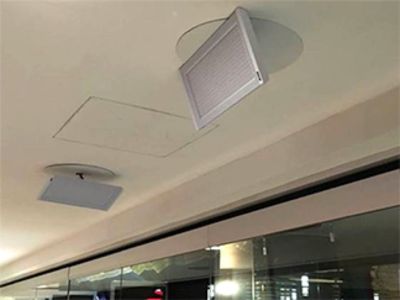
| Installation | Standard | Rack or column | Ceiling / wall, discreet |
| Ideal Use Case | General sound reinforcement | Conference room, church | Targeted zone, privacy |
Directional sound addresses a specific need: delivering a precise audio message in a specific area without disturbing those around it. Here are the key benefits:
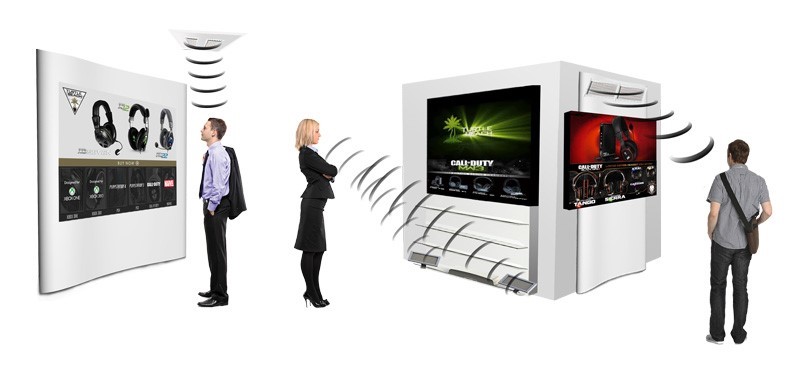
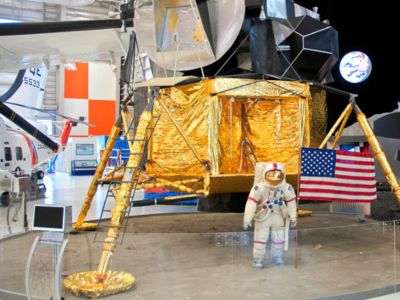
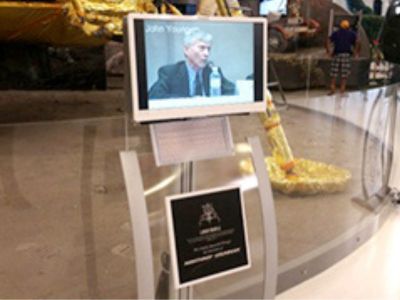
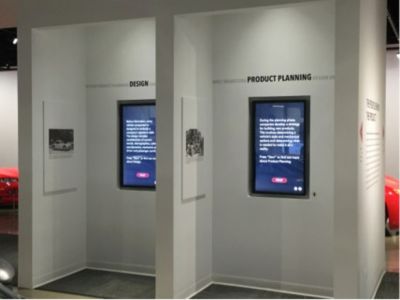
This is one of the most common applications. Each artwork and each display case can have its own audio narration—without headphones, without cables, and without disrupting the overall ambient sound. When a visitor enters the zone, the commentary begins. As they move away, the sound stops.
This system replaces shared audio guides, improves accessibility, and enriches the experience without logistical constraints.
In virtual speaker mode, the sound beam directed at an object creates the illusion that the sound is coming from the object itself—a powerful design tool for immersive exhibitions and art installations.
📐 Allow a minimum distance of 50 cm between two adjacent sound zones to avoid any perceptible interference. In the case of low ceilings (< 2.5 m), opt for an angled wall mount.
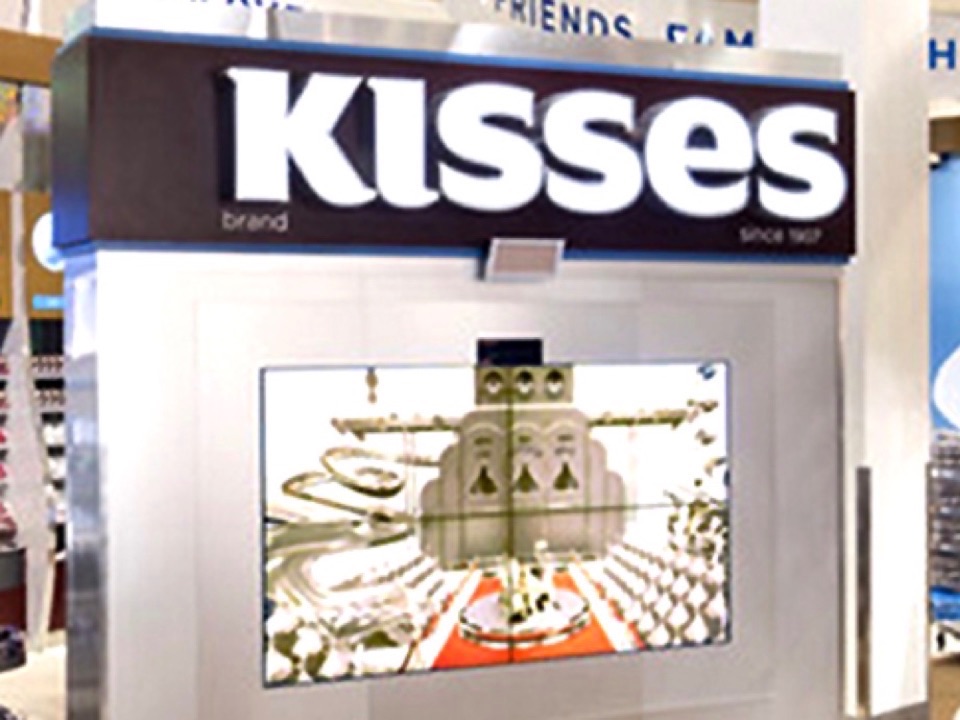
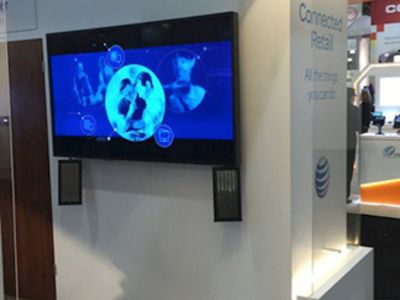
At the point of sale, directional sound allows retailers to target a specific product or aisle with a promotional audio message without flooding the entire store. Activation via motion sensors optimizes impact and reduces noise fatigue for staff.
A directional speaker set to virtual speaker mode can also create an immersive soundscape that envelops the customer without them perceiving where the sound is coming from. An effective tool for sensory marketing and differentiation in premium retail environments.
In train stations, airports, or subway corridors, directional sound allows announcements to be broadcast to a specific location—such as in front of a platform—without the message spreading throughout the entire space and adding to the ambient noise.
In environments where confidentiality is critical—such as emergency rooms and bank teller windows—directional sound allows a customer or staff member to clearly hear information or instructions without nearby people hearing anything.
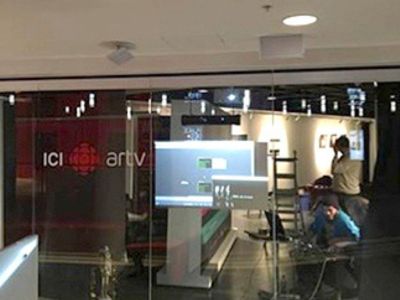
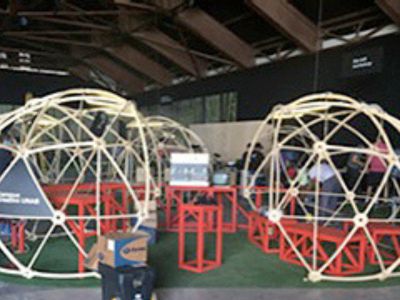
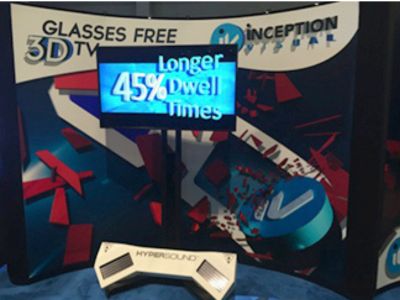
At an exhibition booth, a directional speaker attracts the attention of visitors passing by without disturbing neighboring booths. It is an effective way to stand out without causing a disturbance.













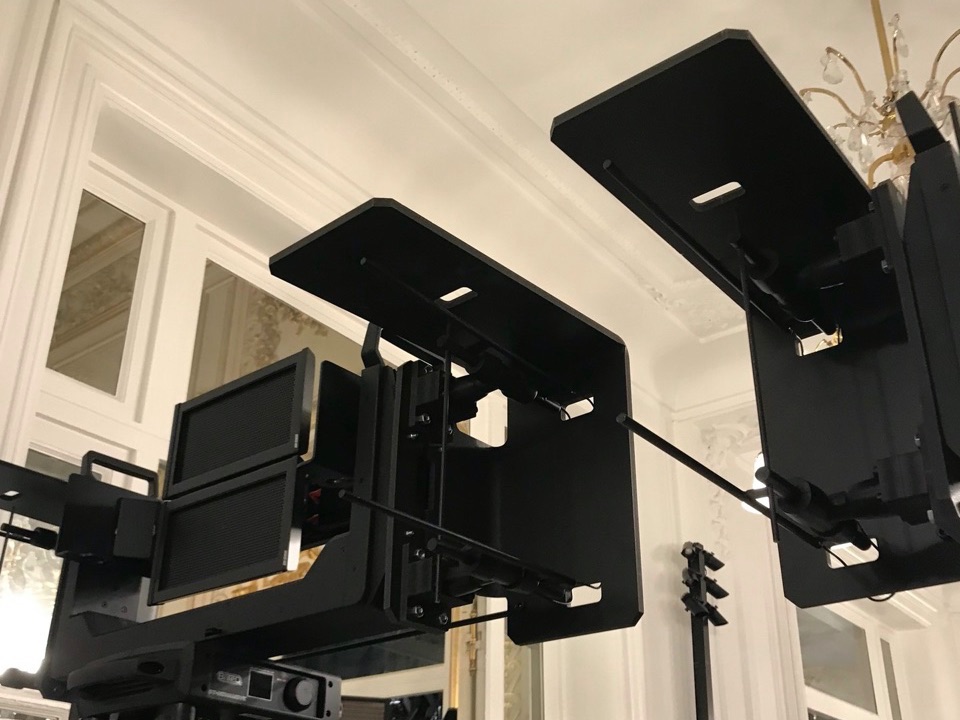
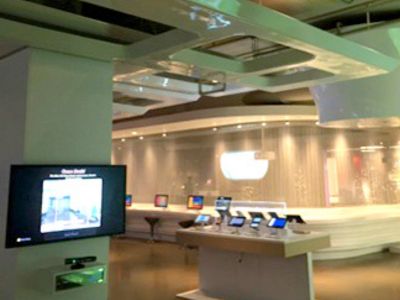

The selection and placement of a directional loudspeaker depend on several technical variables that must be addressed before finalizing the specifications.
For a sound shower installation (vertical beam, top-down), the mounting height directly determines the diameter of the listening area on the floor. With a 15° coverage angle and a mounting height of 3.5 m, the diameter of the listening area is approximately 1.9 m. At 5 m, it increases to 2.7 m.
📐 Calculation formula: diameter = 2 × height × tan(angle/2). This formula should be used systematically during the design phase to verify the expected coverage and avoid overlap between adjacent units.
Parametric demodulation requires a minimum propagation distance to function effectively. At distances shorter than 1 to 1.5 m, the audio signal may be incomplete or degraded. The optimal installation distance is generally between 2.5 m and 4 m for a standard sound shower.
Directional sound is physically limited at low frequencies. Below approximately 200 Hz, the wavelengths become too long to be contained within the beam and propagate in all directions. Directional sound is therefore optimized for speech, sound effects, and musical content in the mid-to-high frequency range (pop, jazz, classical, ambient).
For projects requiring low-frequency reproduction in a specific area, combining the system with a directional subwoofer or using active spectrum management is recommended.
Professional directional speakers typically operate on 100–240 V AC power. Depending on the model, audio inputs may include a 3.5 mm jack, RCA, XLR, or Bluetooth. Some models feature a built-in media player (SD, USB) for standalone installations without an external source.
📐 For installations with contextual triggering, verify compatibility with show control systems (GPIO, RS-232, LAN/IP) and optional infrared or radar presence detectors.